Quick Answer
What Is AEO and GEO?
AEO (Answer Engine Optimization) is the process of structuring content so search engines and AI answer systems can extract clear, direct answers from your page.
GEO (Generative Engine Optimization) is the process of making your content, brand, and expertise more likely to be cited or referenced by generative AI systems such as ChatGPT, Perplexity, and Gemini.
In practical terms: AEO focuses on answer extraction. GEO focuses on AI citation and brand inclusion. SEO remains the technical and content foundation. The best strategy is SEO + AEO + GEO.
Key Takeaways
- ✓AEO helps your content appear as direct answers in featured snippets, AI Overviews, People Also Ask, and voice search.
- ✓GEO helps your brand appear in AI-generated summaries from ChatGPT, Perplexity, Gemini, and Copilot.
- ✓AEO and GEO do not replace traditional SEO — they extend it.
- ✓Google confirms SEO fundamentals still matter for generative AI features in Search.
- ✓AI Overviews can reduce traditional clicks — citations, mentions, and assisted conversions need to be measured.
- ✓Clear answers, structured content, expert authorship, original data, citations, and entity consistency all help.
- ✓Schema helps search engines understand your content but does not guarantee AI visibility.
- ✓Improving content quality and structure is safer than chasing AI-search hacks.
AEO stands for Answer Engine Optimization. GEO stands for Generative Engine Optimization.
Both terms describe a shift in search: people are no longer only clicking through a list of blue links. They are also getting answers from Google AI Overviews, ChatGPT, Perplexity, Gemini, Copilot, voice assistants, featured snippets, and other AI-powered search experiences.
AEO and GEO are not replacements for SEO. They build on the same foundation: crawlable pages, useful content, strong topical relevance, clear structure, trustworthy signals, and technical SEO. Google also confirms that, from its perspective, optimizing for generative AI search is still part of optimizing for Search.
That is why AEO and GEO work best as layers on top of SEO:
- SEO helps your content get discovered and ranked.
- AEO helps your content become the answer.
- GEO helps your content become a trusted source for AI-generated answers.
For a broader explanation of how AI changes search strategy, read the AI SEO guide. If you want to go deeper on the difference between AEO and GEO specifically, read the dedicated article on the difference between AEO and GEO.
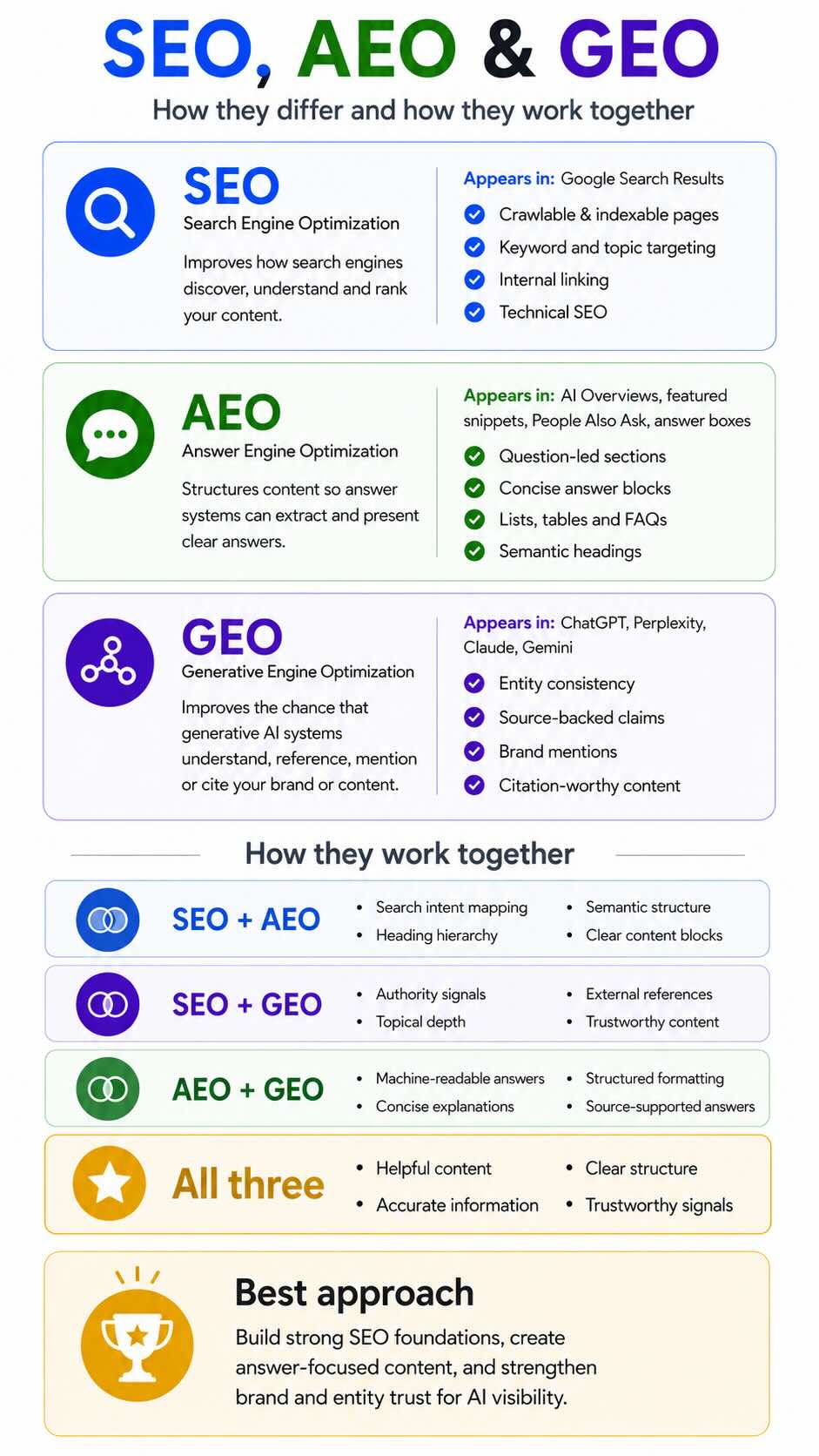
SEO, AEO and GEO in one visual
SEO helps search engines discover, understand and rank your pages. AEO helps answer systems extract and present clear answers. GEO helps generative AI systems understand, reference, mention or cite your brand or content.
What Is AEO?
AEO stands for Answer Engine Optimization.
It is the process of optimizing content so that answer engines can understand, extract, and display your information as a direct answer. An answer engine can be a traditional search feature, a voice assistant, or an AI-powered search result. Examples include:
- Google featured snippets
- People Also Ask boxes
- Google AI Overviews
- Voice search responses
- Knowledge panels
- Bing Copilot answers
- Perplexity answers
- ChatGPT Search responses
AEO is especially important because users increasingly expect immediate answers. They do not always want to open five different pages and piece together the answer themselves.
That changes how content should be written. A traditional SEO article might slowly build context before giving the answer. An AEO-friendly article gives the answer clearly and early, then expands with examples, nuance, sources, and next steps.
Example of AEO in Practice
A weak opening might look like this:
In today's digital marketing landscape, businesses are constantly looking for new ways to improve visibility across different platforms, especially as search engines evolve.
An AEO-friendly version:
AEO is the process of structuring content so search engines and AI tools can extract it as a direct answer to a user's question.
The second version is easier for a user to understand and easier for an answer engine to extract.
What Is GEO?
GEO stands for Generative Engine Optimization.
It is the process of optimizing your content, brand, and digital presence so that generative AI systems are more likely to cite, mention, summarize, or recommend you in their answers.
Where AEO focuses on being the direct answer, GEO focuses on being a trusted source inside generated answers. This matters because generative AI tools may synthesize information from multiple sources, compare brands, summarize expert opinions, and produce a single answer instead of showing a ranked list of websites. For a practical guide on how to get mentioned in ChatGPT, see the dedicated article on improving ChatGPT brand visibility.
GEO applies to platforms such as:
- ChatGPT
- Perplexity
- Google AI Overviews
- Google Gemini
- Bing Copilot
- Claude
- AI search tools built into browsers, apps, and software platforms
The goal is not only to rank. The goal is to become part of the answer.
AEO vs GEO vs SEO: What Is the Difference?
AEO, GEO, and SEO are closely related, but they are not identical.
| Area | SEO | AEO | GEO |
|---|---|---|---|
| Full name | Search Engine Optimization | Answer Engine Optimization | Generative Engine Optimization |
| Main goal | Rank and attract organic traffic | Be extracted as a direct answer | Be cited or used in AI-generated answers |
| Search surface | Google, Bing, traditional SERPs | Featured snippets, PAA, voice, AI Overviews | ChatGPT, Perplexity, Gemini, Copilot, AI Overviews |
| Content focus | Intent, relevance, topical depth, technical quality | Clear answers, question headings, summaries, lists | Evidence, authority, original data, citations, entity consistency |
| Measurement | Rankings, clicks, impressions, CTR, conversions | Featured snippets, AI Overview inclusion, answer visibility | AI citations, brand mentions, AI referrals, share of voice |
SEO helps your page get found. AEO helps your answer get extracted. GEO helps your brand or content get cited by AI.
Why AEO and GEO Matter Now
AI search is changing how people discover information. Google AI Overviews, ChatGPT, Perplexity, Gemini, and Copilot can answer complex questions directly. That means users may not need to click as often, especially for informational queries.
Research from Pew Research Center found that users clicked a traditional search result in 8% of visits when an AI summary appeared, compared with 15% without an AI summary. Users clicked a link inside the AI summary in only 1% of visits.
Ahrefs also found that the presence of an AI Overview correlated with a 58% lower average click-through rate for the top-ranking page in its dataset.
The exact impact varies by industry, query type, and search intent. But the direction is clear: ranking alone is no longer enough. If your target audience is asking AI tools for recommendations, comparisons, or next steps, your brand needs to be visible inside those answers.
This is especially important for B2B service providers, SaaS companies, local businesses, consultants, ecommerce brands, and any company with a long or complex buying journey.
If you want to know how visible your website currently is in AI search, start with an SEO & AI Visibility Review.
How Answer Engines and Generative Engines Work
A traditional search engine mostly returns a ranked list of pages. An answer engine tries to return the answer. A generative engine goes one step further: it may retrieve information from several sources, interpret the query, synthesize the information, and generate a new response.
Google's own documentation explains that generative AI features in Search can use retrieval-augmented generation and query fan-out — Google may retrieve relevant pages from its index, generate related sub-queries, and use those sources to build a more complete answer. Source: Google Search Central
Research into AI Overview source selection found that pages ranking in the top positions are more likely to be cited, but that ranking alone does not guarantee inclusion. Source: arXiv
A separate analysis comparing AI Overviews and Gemini source patterns found meaningful differences in how the two systems select sources even for similar queries. Source: arXiv
That has two important implications: your content still needs to be technically accessible and indexable, and it needs to be genuinely useful as source material, not just keyword-optimized.
The SEO Foundation Still Comes First
AEO and GEO only work properly when the SEO foundation is in place. Before optimizing for AI answers, make sure your website has the basics covered:
- Important pages are crawlable and indexable.
- Canonical tags are correct.
- Internal links point to the right pages.
- The site has a logical structure.
- Pages match the right search intent.
- Content is genuinely useful and not thin.
- Titles, headings, and meta descriptions are clear.
- The page loads quickly and works well on mobile.
- Structured data is implemented correctly where relevant.
- The website demonstrates experience, expertise, authoritativeness, and trust.
Google's guidance on generative AI search is clear: SEO best practices remain relevant because Google's AI features are rooted in its core Search ranking and quality systems. Source: Google Search Central
For help with this part, see my AI SEO services or review examples on the case studies page.
How to Optimize for AEO
AEO is about making your content easy to extract as a direct answer. Here are the most important tactics.
1. Answer the Main Question Early
Do not hide the answer deep in the article. If the page targets "what is AEO and GEO," answer that question near the top, then expand. A good structure is: direct answer → short explanation → example → deeper context → practical steps → FAQ.
2. Use Question-Based Headings
Use headings that match how people ask questions. For example: What is AEO? What is GEO? What is the difference between AEO and GEO? How do you measure AEO and GEO? These headings help answer engines identify which section answers which question.
3. Add Short Answer Blocks
For important subtopics, add a concise answer block before the longer explanation. This format is useful for readers and for extraction by AI systems.
4. Use Lists, Tables, and Summaries
Answer engines often prefer clean, structured information. Use bullet lists, numbered steps, comparison tables, summary boxes, key takeaway sections, FAQ sections, and clear definitions. This makes your content easier to scan and easier to reuse as an answer.
5. Add FAQ Sections
FAQ sections match natural search behavior. Each answer should be concise, accurate, and visible on the page. FAQPage schema can be added when questions and answers are visible to users and implementation follows Google's structured data guidelines. Source: Google Search Central
How to Optimize for GEO
GEO goes beyond answer formatting. It asks a different question: why would an AI system choose your content as a source?
1. Add Original Information
Original information is one of the strongest GEO assets. Examples include your own research, client results, benchmarks, case studies, survey data, real examples, screenshots, and first-hand experience. If your page only summarizes what every other article already says, there is little reason for AI systems or humans to prefer it.
2. Use Statistics and Cite Sources
The foundational GEO research paper found that adding citations, quotations, and statistics improved source visibility by up to 40% in generative engine responses in its experiments. That does not mean every page will get a 40% lift — it means evidence-rich content performed better than generic tactics such as keyword stuffing. Support important claims with credible sources and link to original research.
3. Strengthen Author and Brand Signals
Generative AI systems may also pick up signals about the author, company, and brand across the web. Helpful signals include a clear author bio, LinkedIn profile, SameAs schema, case studies, client testimonials, consistent company descriptions, reviews, and third-party mentions.
4. Build Entity Consistency
Entity consistency means your brand is described in the same way across your website and external profiles. A consistent entity profile helps AI systems understand who you are, what you do, which topics you are associated with, and why you are credible. Your About page, author bio, service pages, LinkedIn profile, schema markup, and third-party mentions should tell a consistent story.
5. Create Content Worth Citing
The best GEO content gives AI systems something specific to reference — your own data, a comparison table, a real audit example, a clear framework, or a step-by-step workflow. AI systems do not need another generic article. They need reliable source material.
A Practical AEO/GEO Workflow
Here is a simple workflow you can use to optimize an existing page.
Step 1: Check the SEO Foundation
Is the page indexed? Does it have a clear target query? Does it match search intent? Is the title clear? Are internal links pointing to the page? Is the page fast enough? Is the content original and useful?
Step 2: Add the Direct Answer
Add a short answer near the top of the page. Give users an immediate answer and make the page easier to extract.
Step 3: Restructure Headings Around Questions
Turn vague headings into question-based or intent-based headings. Replace "Core Principles" with "How Do You Optimize for AEO?" Replace "Platform Ecosystem" with "Which Platforms Do AEO and GEO Apply To?"
Step 4: Add Comparison Tables
Tables are useful when readers need to compare concepts — for example: SEO vs AEO vs GEO, AEO tactics vs GEO tactics, or common mistakes and fixes. Tables also make your content easier to cite and summarize.
Step 5: Add Evidence
Review every important claim and ask: Is this sourced? Is this current? Is this specific? Is it based on research, official documentation, or real experience? Strong sources for AEO/GEO content include Google Search Central, academic research, Pew Research, Ahrefs, Semrush, and original case studies.
Step 6: Add Schema Markup
For this type of page, consider Article, FAQPage, BreadcrumbList, Person, Organization, and WebPage schema. Schema will not guarantee AI visibility, but it helps search engines understand the content, author, organization, and page structure.
Step 7: Track AI Visibility
Run a recurring prompt audit across multiple AI platforms. Test prompts such as "What is AEO and GEO?", "Who offers AEO/GEO services?", and "What is the difference between SEO, AEO, and GEO?" Track whether your brand is mentioned, which sources are cited, and which competitors appear.
Technical Optimization for AEO and GEO
Technical SEO still matters because AI systems cannot use content they cannot access, crawl, render, or understand.
Google states that pages need to be indexed and eligible to appear with a snippet to be eligible for its generative AI features in Search. Source: Google Search Central
Key technical priorities:
- Crawlability: Check robots.txt, meta robots, canonical tags, sitemap, redirect chains, and JavaScript rendering issues.
- Semantic HTML: One clear H1, logical H2/H3 hierarchy, descriptive anchor text, alt text for useful images.
- Structured data: Article, FAQPage, BreadcrumbList, Person, Organization, and WebPage schema where applicable.
- Page experience: Fast load times, mobile-friendly layout, readable typography, no intrusive pop-ups.
Schema should clarify the page, not attempt to manipulate search results. Avoid adding schema that does not match visible content.
How to Measure AEO and GEO
Traditional SEO measurement is still important, but it is no longer enough on its own. You should still track rankings, organic clicks, impressions, CTR, conversions, indexed pages, technical errors, backlinks, and internal links.
AEO Metrics
Track featured snippet wins, People Also Ask visibility, AI Overview citations, zero-click query exposure, FAQ visibility, and changes in CTR for affected queries. Google Search Console can help identify query and page-level trends.
GEO Metrics
Track brand mentions in ChatGPT, Perplexity, Gemini, and Copilot. Track source citations in AI-generated answers, AI referral traffic, competitor mentions, accuracy of AI-generated brand descriptions, and share of voice across prompt sets. A simple spreadsheet works well for tracking prompts, platforms, dates, citations, and action items.
Business Metrics
Also monitor branded search growth, direct traffic, assisted conversions, lead quality, and sales conversations mentioning AI search. AI search may influence the buyer journey before it shows up as a clean last-click conversion.
Common AEO and GEO Mistakes
| Mistake | Why it fails | Better approach |
|---|---|---|
| Treating AEO/GEO as SEO replacements | AI tactics don't fix weak content or crawl issues | Start with SEO. Add AEO and GEO layers on top. |
| Writing only for AI systems | Creates robotic content that users don't engage with | Write for people. Structure for machines. |
| Publishing generic AI-generated content | Gives AI systems little reason to prefer your source | Add original examples, data, experience, or perspective. |
| Overestimating schema | Schema doesn't guarantee AI citations or snippets | Use schema as a clarity layer, not a shortcut. |
| Ignoring off-site signals | GEO footprint is weak if brand only exists on own website | Build reviews, directory listings, and third-party mentions. |
| Measuring only organic clicks | Misses AI-influenced journeys that convert later | Track citations, brand search, and assisted conversions. |
AEO and GEO Examples
Example 1: Local Service Business
Optimize for questions such as "What is the best [service] near me?" and "Is [brand] a good option?" AEO improvements: FAQ sections, clear pricing explanations, concise answer blocks. GEO improvements: reviews, local citations, Google Business Profile optimization, expert bios, and third-party mentions.
Example 2: B2B SaaS Company
Optimize for comparison and decision-stage prompts such as "[Brand] vs [competitor]" and "Best tools for [use case]." AEO improvements: comparison tables, product explainers, FAQ content. GEO improvements: original benchmarks, third-party reviews, customer stories, and clear entity signals.
Example 3: Consultant or Expert
Optimize for expertise-driven prompts such as "Who is an expert in [topic]?" and "Best consultant for [problem]." AEO improvements: clear educational content and practical frameworks. GEO improvements: case studies, LinkedIn consistency, author schema, testimonials, niche-specific content, and external mentions.
For example, my work around SEO, AEO, and GEO is explained across the services, case studies, and AI SEO guide pages.
AEO/GEO Checklist
SEO Foundation
- Page is indexable and crawlable
- Clear target query and matched search intent
- Clear title, meta description, and H1
- Logical heading hierarchy
- Internal links added
- Correct canonical tag
- Fast load time, mobile-friendly
- Original, useful content
AEO Structure
- Direct answer near the top
- Question-based H2s and H3s
- Short answer blocks
- Bullet lists where useful
- Comparison tables
- Visible FAQ section
- Concise, extractable explanations
GEO Authority
- Original examples or research
- Expert commentary
- External citations from reliable sources
- Statistics with sources
- Author bio with relevant experience
- Organization information
- Case studies or testimonials
- Consistent entity signals across pages and profiles
Technical and Schema
- Article or BlogPosting schema
- FAQPage schema (matching visible content)
- BreadcrumbList schema
- Person and Organization schema
- Semantic HTML throughout
- Descriptive internal links
Measurement
- Organic rankings and GSC data
- Featured snippet and AI Overview visibility
- AI mentions across ChatGPT, Perplexity, Gemini, Copilot
- AI referral traffic in analytics
- Branded search trends
- Assisted conversions
Conclusion
AEO and GEO are not magic tricks. They are practical extensions of SEO.
AEO helps your content become easier to extract as a direct answer. GEO helps your content and brand become more useful as a source for generative AI systems. Both depend on the same underlying foundation: strong SEO, helpful content, technical clarity, authority, and trust.
The biggest mistake is treating AEO and GEO as shortcuts. They work best when your website already answers the right questions, demonstrates real expertise, and gives search engines and AI systems clear, reliable information to work with.
The most practical way to start:
- Audit your existing high-value pages.
- Add direct answers and better structure.
- Support claims with credible sources.
- Strengthen author, brand, and entity signals.
- Track AI mentions and citations across platforms.
- Keep improving based on what AI systems actually cite.
If you want to know where your website currently stands, request an SEO & AI Visibility Review, or view my SEO services and pricing.
Frequently Asked Questions
What is AEO?
AEO stands for Answer Engine Optimization. It is the process of structuring content so search engines, voice assistants, and AI search systems can extract it as a direct answer to a user's question.
What is GEO?
GEO stands for Generative Engine Optimization. It is the process of optimizing your content, brand, and online presence so generative AI systems are more likely to cite, mention, summarize, or recommend you in AI-generated answers.
What is the difference between AEO and GEO?
AEO focuses on direct answer extraction. GEO focuses on AI-generated citations, mentions, and source inclusion. AEO is about becoming the answer. GEO is about becoming a trusted source used in generated answers.
Is GEO replacing SEO?
No. GEO does not replace SEO. GEO builds on SEO. Your content still needs to be crawlable, indexable, useful, technically sound, and trustworthy before it has a strong chance of appearing in AI search experiences.
Is AEO the same as AI SEO?
AEO is one part of AI SEO. AI SEO is a broader term that can include traditional SEO, AEO, GEO, entity optimization, structured data, technical SEO, AI visibility tracking, and content optimization for AI-powered search.
Does schema help with AEO and GEO?
Schema can help search engines understand your content, author, organization, and page structure. However, schema does not guarantee AI citations or AI Overview visibility. It should be used as a clarity layer, not as a shortcut.
Do I need llms.txt for Google AI Overviews?
No. Google says you do not need special machine-readable AI files, markdown files, or llms.txt files to appear in Google Search or its generative AI features. Google also says llms.txt does not help or harm visibility in Google Search.
How do you optimize a page for AEO?
Answer the main question early, use question-based headings, add concise answer blocks, use lists and tables, include FAQs, and make the page easy to scan. The goal is to make the answer clear for both users and answer engines.
How do you optimize a page for GEO?
Add original insights, credible sources, expert quotes, data, case studies, clear author information, consistent brand signals, and third-party authority. GEO is about making your content worth citing.
How do you measure AEO and GEO?
Measure featured snippets, People Also Ask visibility, AI Overview citations, AI mentions, AI referral traffic, branded search, assisted conversions, and the accuracy of AI-generated answers about your brand.
Are AEO and GEO only relevant for large brands?
No. Small businesses can benefit from AEO and GEO by answering specific customer questions clearly, building topical authority, improving local and entity signals, collecting reviews, and creating useful service or comparison pages.
What is the first step in AEO/GEO optimization?
The first step is an audit. Check whether your important pages are technically sound, answer the right questions, include clear direct answers, demonstrate expertise, and appear correctly in AI-generated responses. Contact me if you want help with this.